
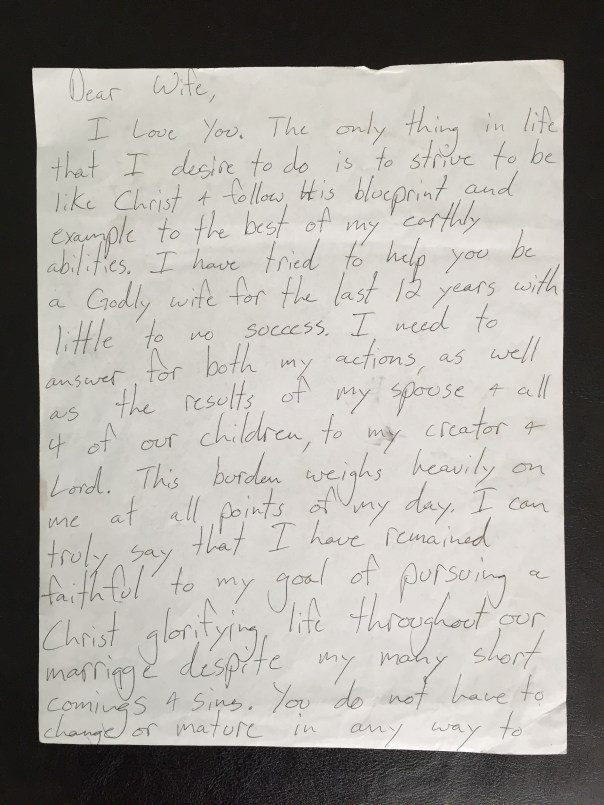
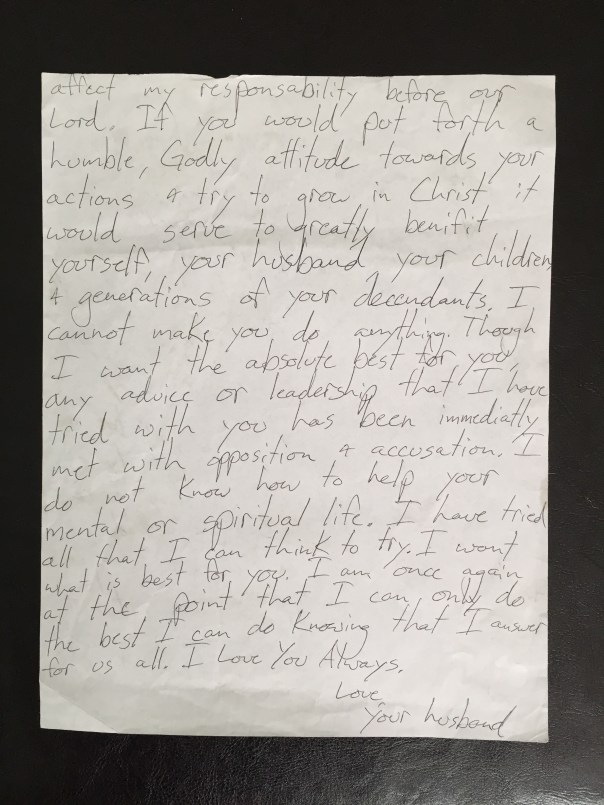
I spent most of my marriage dealing with abuse – mainly mental/emotional, but also financial, sexual, and occasionally physical. Being that I was also a Christian and we kept ourselves planted in the church, we frequently needed to reach out to our spiritual leaders to help us with our struggling marriage. Through all those years, the only time anyone specifically acknowledged abuse in my marriage was after the “big” moments (ie: the gun incident). For all the other times we would hit rock bottom, the advice was usually for me to respect him more so that in turn, he would respond by loving me more (and abusing me less). The advice placed the responsibility of his abuse on my shoulders. If I did XYZ, he would respond positively by doing ABC. We called it the spiral. It could go up, or it could go down. All advice pointed back to that spiral – stop the downward spiral by focusing on what I could do to improve ME and MY behaviors, and the result would make him more willing and likely to improve HIS behaviors, thus reversing the spiral.
In a healthy marriage, this isn’t actually bad advice – if BOTH partners are honestly and genuinely striving for self-improvements. Obviously we should all be purposeful in being the best human we can be, and driven to treat our partner well. The problem lies when one party is unwilling to change, but we say that if the other party just tries harder, respects more, loves better… THEN the unwilling party might have a change of heart.
Do you see how damaging this could be? This is victim blaming. How about I reword it like this: “If you DIDN’T do XYZ, then he wouldn’t have ABC.” “If you didn’t yell at him, he wouldn’t have hit you.” “If you didn’t dress that way, he wouldn’t have raped you.” It makes the non-abuser at fault for the abuse. There’s a line where healthy consequences end (One partner overspends and leaves no money to pay bills, so the mutually agreed upon boundary is to give the overspender a set allowance) and abuse begins (one partner has no issues with finances but the other partner has complete control, doesn’t allow access to bank accounts, imposes an allowance, puts the family in financial distress, etc).
If we can get better at identifying abuse and calling it what it is and getting to the root of that problem, I truly feel things can improve. There’s one area where I believe needs to change, and that’s how we speak of this abuse. One thing that I frequently see from those getting out of a relationship is people saying they “don’t want to badmouth their ex”. While I can see this as a positive practice in “normal” relationships that end for “normal” reasons (and absolutely necessary to an extent when it comes to how we speak to our children), I can’t help but think that this practice of keeping silent does more harm than good in situations where abuse has been present.
Had more people in the position of power (in my case, spiritual power) stepped up and spoke up in my life to tell me that what I was experiencing was ABUSE rather than the normal difficulties that arise in marriage, maybe things could have turned around sooner – whether it be healing and true change, or me not going back into that abusive relationship only to have the abuse change and increase over the years following.
I think sometimes we aren’t willing to speak up against abuse because we are so afraid of it looking like we are badmouthing someone. But what if speaking out about our experiences could literally save a life? What if someone heard our story and could identify a pattern of ABUSE in their life. What if bystanders heard our story and THEY were the ones able to help a friend identify abuse. What if we had the power to stop the cycle because we were brave enough to share our story? This isn’t about promoting divorce. There is help out there for abusive people. People CAN change (though there’s no guarantee they will). But in order to change, we have to diagnose and treat the correct problem. I feel like what we do in the Church, by treating abusive marriages just like any other struggling marriage, is like giving an anti-depressant to someone needing an antibiotic. Identify the problem and then you can find the tools to heal it at the root OR do the necessary surgery to remove the problem.
One common recommendation for survivors with PTSD is to talk about the trauma they endured. This can be in a mental health setting (counseling/therapy), or in a group setting (support group), or simply sharing our story with friends or even strangers that might benefit from hearing of our experiences. Not only is this healing to the survivor, but it can be life saving and life giving to someone has been in or is currently experiencing a similar situation.
If someone had their home broken into, we wouldn’t tell that person to not share their experience. In fact, their story might make its way to the news, as a way to warn others in the neighborhood about this dangerous person, and to give people ways to protect themselves.
If a woman was raped, we wouldn’t tell her to keep quiet about her abuse. We would want to plaster a picture of her abuser everywhere so that others could be on the lookout for this harmful person, and be prepared in the event they crossed paths with this individual.
Why is it that speaking up about abusive marriages (especially in the Christian/religious world) is taboo? I want others to know what various types of abuse can look like, and how they can protect themselves from getting into an abusive relationship. I want others to know that there are ways they can help identify and stop abuse and heal and save a relationship. I want people to know that there are ways they can protect themselves and remove themselves from the abuse in a healthy and safe way.
Speaking up about abuse, whether it be physical, mental, financial, or sexual (to include adultery) doesn’t have to be bad mouthing. It can be – and SHOULD BE – prevention.
Lord, let me be the lighthouse that saves others from crashing into the same rocks I hit along the way, but let me do it with grace-filled lips, without bitterness, and full of Truth.
 the incandescent life